
ESMA Clarifies Reverse Solicitation Rules Under MiCA


European Union crypto clients should be served through a Markets in Crypto-Assets Regulation (MiCA)-authorized legal entity after the bloc’s July 1 transitional deadline, the European Securities and Markets Authority (ESMA) told Cointelegraph, adding to questions over how global exchanges can keep servicing users in the region.
Crypto asset service providers (CASPs) must hold MiCA authorization to serve clients across the EU and European Economic Area, an ESMA spokesperson told Cointelegraph on Monday.
“EU clients should be serviced through a MiCA-authorized entity,” the ESMA representative said, adding that MiCA protections apply only to the legal entity that is licensed in the EU.
The clarification came shortly after Binance told its users it was adjusting services in certain EU countries, including Poland, France, Spain and Italy, as part of its MiCA transition. Binance said users in other countries would not need to take action if they were not based in a jurisdiction where the exchange operates through a local registered entity, saying in those cases that “no action is required at this time.”
ESMA cites “narrow exemption” for non-EU CASPs
The ESMA said CASPs based outside the EU cannot provide their services to local customers unless they fall under the “narrow exemption” of reverse solicitation provided by Article 61 of MiCA.
Article 61 allows a non-EU crypto company to serve an EU client without a MiCA license only when the client initiates the relationship entirely on their own, without any solicitation, marketing or promotion by the company.
However, the regulation makes clear that the exemption does not apply if a third-country company solicits clients in the EU.
“MiCA established that where a third-country firm solicits clients or prospective clients in the Union […] it shall not be deemed to be a service provided on the client’s own exclusive initiative,” an ESMA spokesperson told Cointelegraph.
Excerpt from ESMA’s list of examples of solicitation by third-country companies. Source: ESMA
The regulator also cited its official solicitation guidelines, which include activities such as operating websites, mobile apps, social media, online advertising, sponsorships and influencer campaigns targeting EU users.
Lawyer questions Binance’s Abu Dhabi servicing model
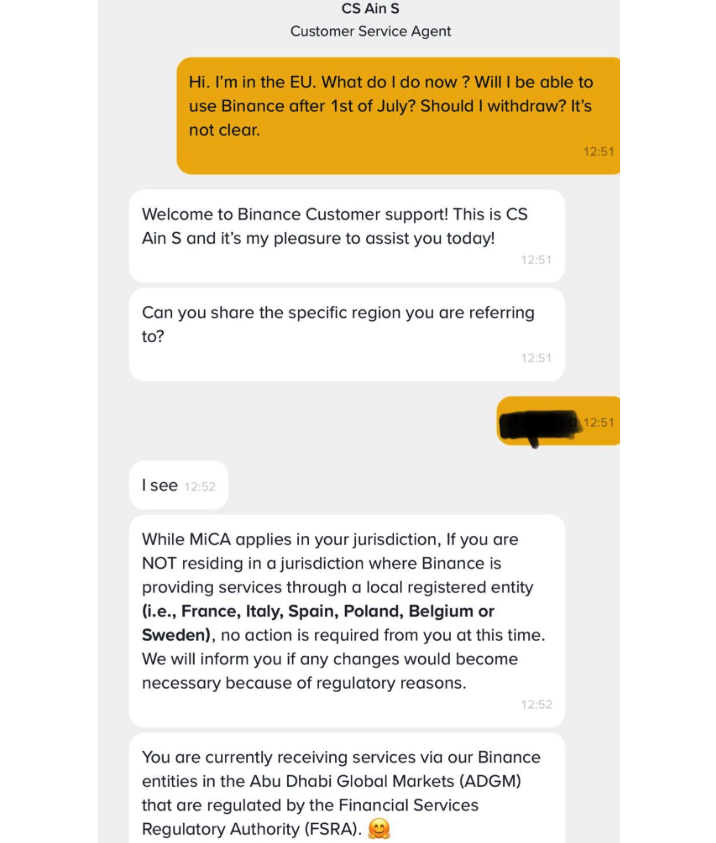
Screenshots of Binance customer support messages circulating on social media appeared to suggest that some EU users could be serviced through Binance’s Abu Dhabi Global Market entity.
Yuriy Brisov, a lawyer at Digital & Analogue Partners, said an Abu Dhabi license has no effect under MiCA because the jurisdiction is treated as a third country, alongside markets such as the United States or Singapore.
Source: Satoshi Club
“Being regulated in Abu Dhabi does nothing for Binance under MiCA,” Brisov said. “When Binance says some EU users are serviced through the ADGM entity, in MiCA terms that means a non-EU company is serving those users,” he added.
Related: Germany leads MiCA crypto authorization race as Europe’s deadline looms
Brisov said that the reverse solicitation exemption was designed for isolated cases where an EU customer independently approaches a non-EU company, not for maintaining an existing customer base built through years of marketing.
Binance did not respond to repeated Cointelegraph requests for clarification on whether any EU users would be serviced through its ADGM entity after the MiCA deadline.
Magazine: How crypto laws changed in 2025 — and how they’ll change in 2026



