
Bitcoin Price Nears 4 Million Lira as Turkey’s Currency Hits the Floor


Key Takeaways
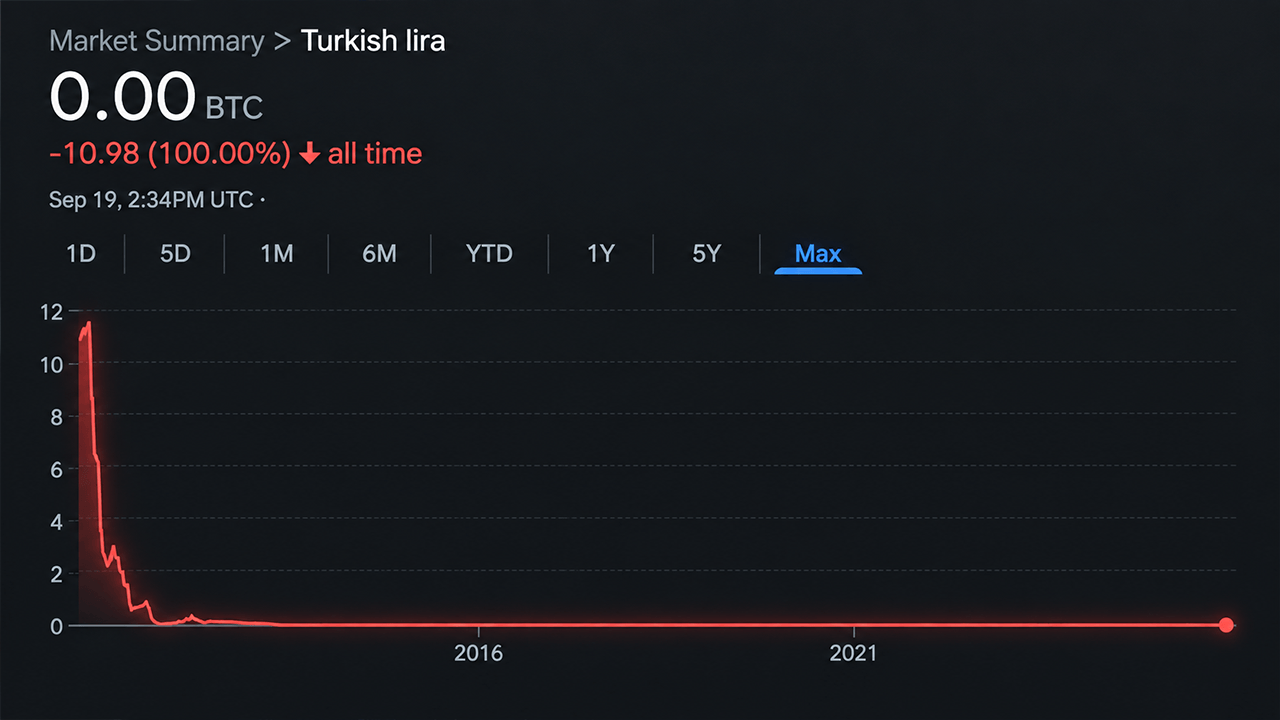
- Turkey’s lira is near 48.8 per dollar, while a single bitcoin now costs almost 4 million lira.
- TCMB rates sit at 37%, but with inflation at 31.51%, Turkish savers are still feeling the squeeze.
- Turkey lets people buy and hold bitcoin, but its 2021 rule still says they can’t spend it directly.
Nearly 4 Million Lira for One Bitcoin
Five years ago, a Turkish saver needed fewer than nine lira to buy a U.S. dollar. Today, that same greenback costs nearly 49. Against bitcoin (BTC), the numbers have gone completely off the rails. One bitcoin now changes hands for roughly 3.95 million to 3.96 million lira, turning what was once an ordinary-looking exchange rate into a seven-digit price tag.
The strange part is that Turkey hasn’t suffered a sudden currency collapse. The lira has instead been bleeding purchasing power gradually, losing roughly 18% against the dollar over the past year and about 86% of its purchasing power over five years based on official inflation. It’s a slow-motion squeeze inside an economy still measured at roughly $1.4 trillion to $1.6 trillion.
A 37% Interest Rate Still Isn’t Much Shelter
Official inflation came in at 31.51% in August, while the independent inflation group ENAG calculated 49.03%. Housing, water, electricity, and gas prices were 39.77% higher than a year earlier, food was up 33.79%, and transport climbed 35.08%. That makes the Central Bank of the Republic of Türkiye’s 37% policy rate look less extraordinary than it sounds.
Against the official inflation reading, savers receive a relatively thin real return. Against ENAG’s estimate, they’re still losing ground. Turkey’s dependence on imported energy makes matters harder. Oil and other imports must largely be paid for in foreign currency, meaning a weaker lira raises domestic costs. On the other hand, policymakers have reasons to tolerate gradual depreciation because a cheaper currency can help Turkish exporters compete abroad.
$600 Billion Sitting ‘Under the Pillow’
Turkish households haven’t exactly been caught flat-footed. Officials estimate roughly $600 billion worth of household gold sits outside the banking system, much of it physical coins and jewelry traditionally described as being kept “under the pillow.” Stablecoins and bitcoin (BTC) are likely included in those under the pillow stashes.
Foreign currency remains another escape hatch, accounting for roughly 38% to 41% of deposits, while property offers another place to store wealth. Crypto has joined that list. Türkiye ranked 14th on Chainalysis’ 2025 Global Crypto Adoption Index and led the Middle East and North Africa by transaction volume at roughly $200 billion annually. Bitcoin and USDT, in that context, can look less like speculative toys and more like alternative savings instruments.
Bitcoin Is Legal, but Don’t Buy Lunch With It
Here’s the regulatory twist. Turkish residents can legally buy, hold, and sell bitcoin, but a 2021 central bank rule prohibits using crypto to pay directly for goods and services. Residents can fund regulated platforms with lira, purchase bitcoin or USDT, and later convert those assets back into lira. Turkey’s 2024 Crypto Asset Law also brought platforms under the Capital Markets Board, tightening oversight while leaving trading itself legal.
So a Turkish saver can watch one bitcoin approach 4 million lira, buy a fraction of it legally, and hold it as an alternative to cash. They just can’t spend it at the checkout counter. With official inflation still above 31% and the lira setting fresh records in the wrong direction, what Turks choose to call “money” is becoming a surprisingly complicated question.



