California Orders $4.8M Payout to Bitcoin ATM Scam Victims


Key Takeaways
- Coinflip must pay more than $4.8 million in victim compensation.
- Transactions exceeded California’s $1,000 daily customer limit.
- Coinflip must also pay the regulator over $350,000 in excessive fees.
Coinflip Faces Compensation Order Over Fraud Safeguards
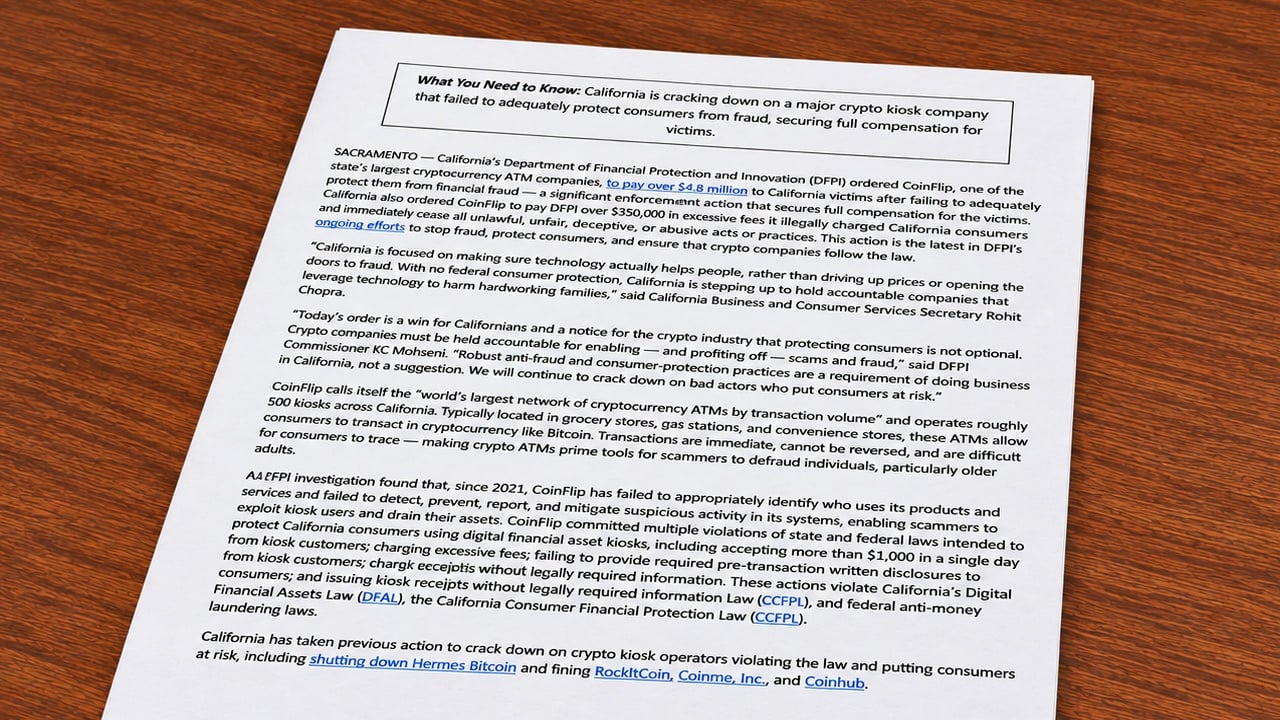
California’s Department of Financial Protection and Innovation (DFPI), the state’s financial regulator, announced Nov. 4 that it ordered Coinflip to pay more than $4.8 million to California scam victims. The agency described the required payments as full compensation. Its order against Coinflip also requires the company to pay DFPI over $350,000 in illegally charged excessive fees.
Investigators found that, since 2021, the operator had failed to adequately identify users and detect, prevent, report, and mitigate suspicious activity. Those failures enabled scammers to exploit customers and drain their assets, the agency said. DFPI Commissioner KC Mohseni stated:
“Robust anti-fraud and consumer-protection practices are a requirement of doing business in California, not a suggestion.”
The findings included transactions exceeding the $1,000 daily customer limit, missing written disclosures before purchases, and incomplete receipts. DFPI cited the Digital Financial Assets Law, which regulates crypto businesses and sets kiosk safeguards, and federal anti-money laundering requirements. It also cited the California Consumer Financial Protection Law, which prohibits unlawful, unfair, deceptive, or abusive financial practices.
Kiosk Scams Exploit False Claims That Money Needs Protection
Coinflip’s California machines typically operate in grocery stores, gas stations, and convenience stores, according to DFPI. The regulator described kiosk transactions as immediate, irreversible, and difficult for consumers to trace. It identified older adults as particularly vulnerable to fraud involving these machines.
Scammers use fraudulent support messages and impersonation tactics to pose as trusted organizations and fabricate account problems. The Federal Trade Commission has described schemes beginning with suspicious-activity claims or computer security warnings. Victims are then pressured to withdraw cash and move it through a nearby kiosk.
In these bitcoin ATM impersonation scams, a supplied QR code directs the purchased cryptocurrency into a fraudster’s wallet. Government, business, and technical support impersonation accounted for about 86% of kiosk fraud loss reports in the first half of 2024. People 60 and older accounted for about 71% of reported losses involving the machines during that period.
Beyond compensation, California ordered Coinflip to cease unlawful, unfair, deceptive, or abusive practices, continuing enforcement against multiple kiosk operators. Earlier actions included shutting down Hermes Bitcoin and imposing financial sanctions on RockItCoin, Coinme, and Coinhub. DFPI maintains a Crypto Scam Tracker and accepts consumer fraud complaints.
States Pursue Operator Refunds and Investigative Recoveries
Arizona secured full refunds for 35 crypto ATM victims totaling $171,332, announced Aug. 12. Its mandatory reimbursement provisions cover qualifying customers who had been with an operator for fewer than 10 days. Eligibility also requires reporting within 30 days and documentation confirming fraudulent inducement.
Separately, Alabama’s crypto ATM scam refund requirements took effect Oct. 1. Qualifying new customers can receive the full transaction amount plus fees, while existing customers qualify for half the value plus all fees. Both groups face a 60-day reporting deadline.
Ohio investigators secured the return of $15,300 stolen through a crypto ATM in a fake Microsoft support scheme. A 63-year-old woman received her money back Oct. 8 after investigators traced and froze the funds. Agents coordinated with the Allen County Prosecutor’s Office and obtained a search warrant.